What makes a good pet portrait?
A good pet portrait should do one thing above all else: look unmistakably like the pet it was created to represent.
That doesn't mean reproducing every detail of a photograph or making the artwork as realistic as possible. Recognisable likeness comes from getting the important things right - the proportions, features, markings and familiar expression that make one animal different from another.
Artistic style matters too. So do the reference photographs, materials, composition and quality of the finished artwork. But technical detail alone can't make up for a portrait that doesn't quite look like the pet.
Whether you're choosing an artist for your own pet, commissioning a portrait as a gift or looking for memorial artwork, this guide explains what to look for in a good pet portrait and how to judge the quality of an artist's work.
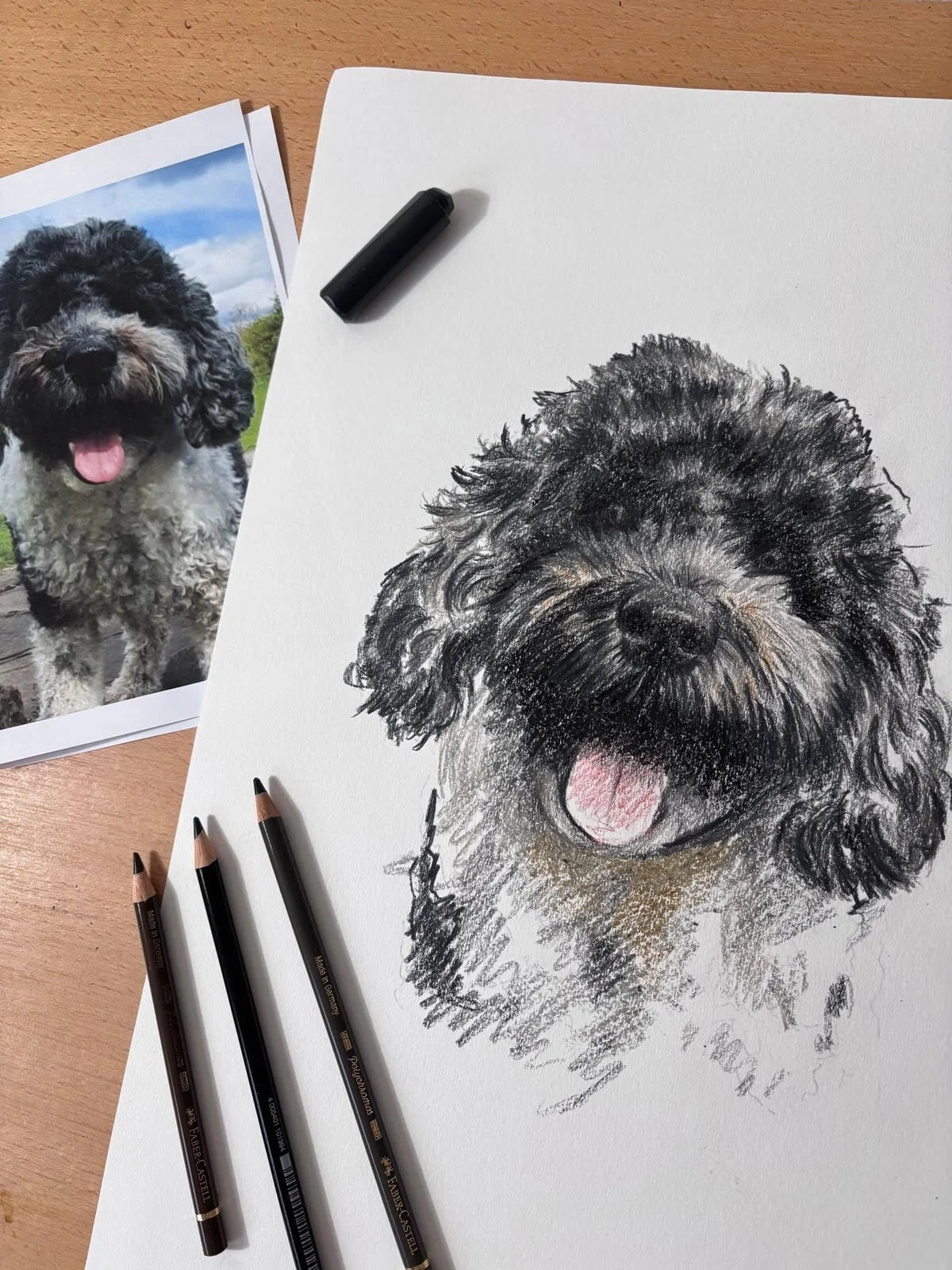
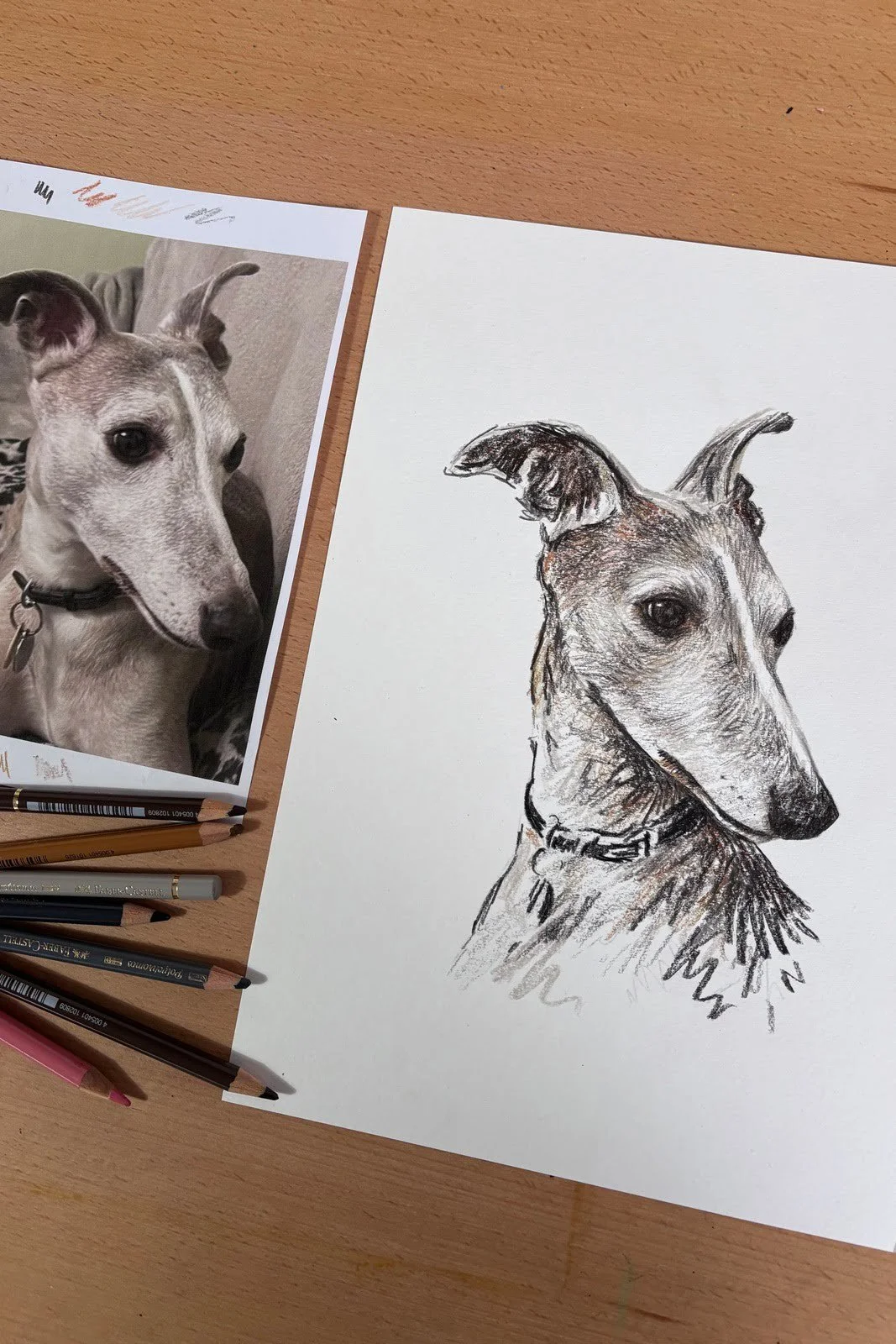
Original pet photograph displayed beside a finished hand-drawn pet portrait
Pet portrait quality: the quick answer
A good pet portrait should combine recognisable likeness, accurate features and an artistic style you genuinely like.
When you're looking at a finished portrait, consider:
Likeness – would someone who knows the pet recognise them immediately?
Expression – does it show a look that feels familiar to the owner?
Proportions – are the shape of the head, muzzle, eyes and ears convincing?
Colour and markings – have distinctive coat patterns and colours been represented accurately?
Composition – does the crop and positioning work as a finished piece of artwork?
Artistic style – do you actually like the way the artist draws or paints?
Craftsmanship – does the finished artwork show consistent skill and appropriate use of the chosen materials?
Not every good pet portrait needs to be highly realistic or contain huge amounts of detail. A loose watercolour, contemporary drawing or detailed oil painting can all be successful in very different ways.
For me, the most important test remains the simplest:
Would the person who knows this pet best look at the finished portrait and immediately know it's them?
Everything else should build from that foundation.
1. A strong, recognisable likeness
The most important part of a good pet portrait is recognisable likeness.
It's possible to draw beautifully detailed fur, convincing eyes and realistic textures but still create a portrait that doesn't quite look like the individual pet.
That's because likeness depends on the underlying features and proportions being right.
Small differences can have a surprisingly large effect, including:
The overall shape of the head
The distance and position of the eyes
The length and width of the muzzle
The size, shape and position of the ears
The angle at which the head is held
Distinctive facial and coat markings
These details are particularly important with pets of the same breed. Two Cocker Spaniels, Labradors or Chihuahuas may share obvious breed characteristics, but they still have individual proportions and features that distinguish one from another.
For me, these fundamentals come before finer details such as individual hairs or surface texture. Once the underlying likeness feels right, the rest of the portrait can be developed around it.
A useful test when looking through an artist's portfolio is to find examples where they show the reference photograph alongside the finished portrait. That allows you to judge the likeness for yourself rather than simply judging how technically impressive the drawing or painting appears.
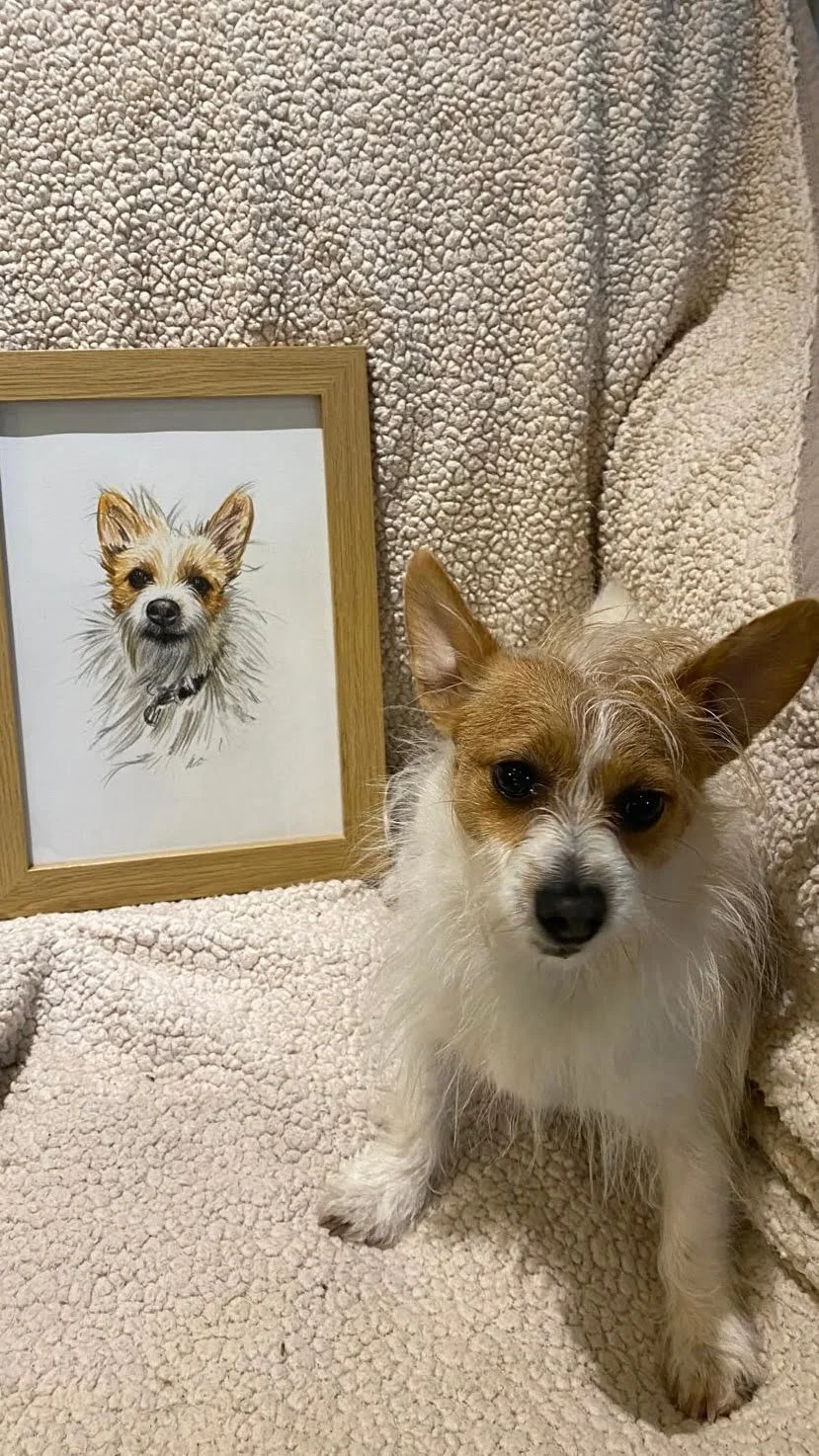
Hand-drawn pet portrait displayed beside the pet it was created from
2. The right expression
A pet's expression can be just as important to recognisability as their physical features.
The same animal can look noticeably different depending on whether their ears are raised or relaxed, their mouth is open or closed, their eyes are alert or sleepy, or their head is held at a particular angle.
That's why the technically clearest photograph isn't always the best photograph for a portrait.
For example, you might have a perfectly sharp photograph of your dog looking directly at the camera, but another slightly less polished image may show the expression you recognise immediately as them.
When choosing a reference photograph, look for familiar details such as:
The position and shape of the ears
The direction of the eyes
Whether the mouth is open or closed
The angle of the head
The overall expression you see regularly at home
A good portrait artist should preserve those familiar characteristics rather than simply creating a generic representation of the breed.
If you're unsure which photograph best represents your pet, I can review several images and help you choose the strongest reference before drawing begins.
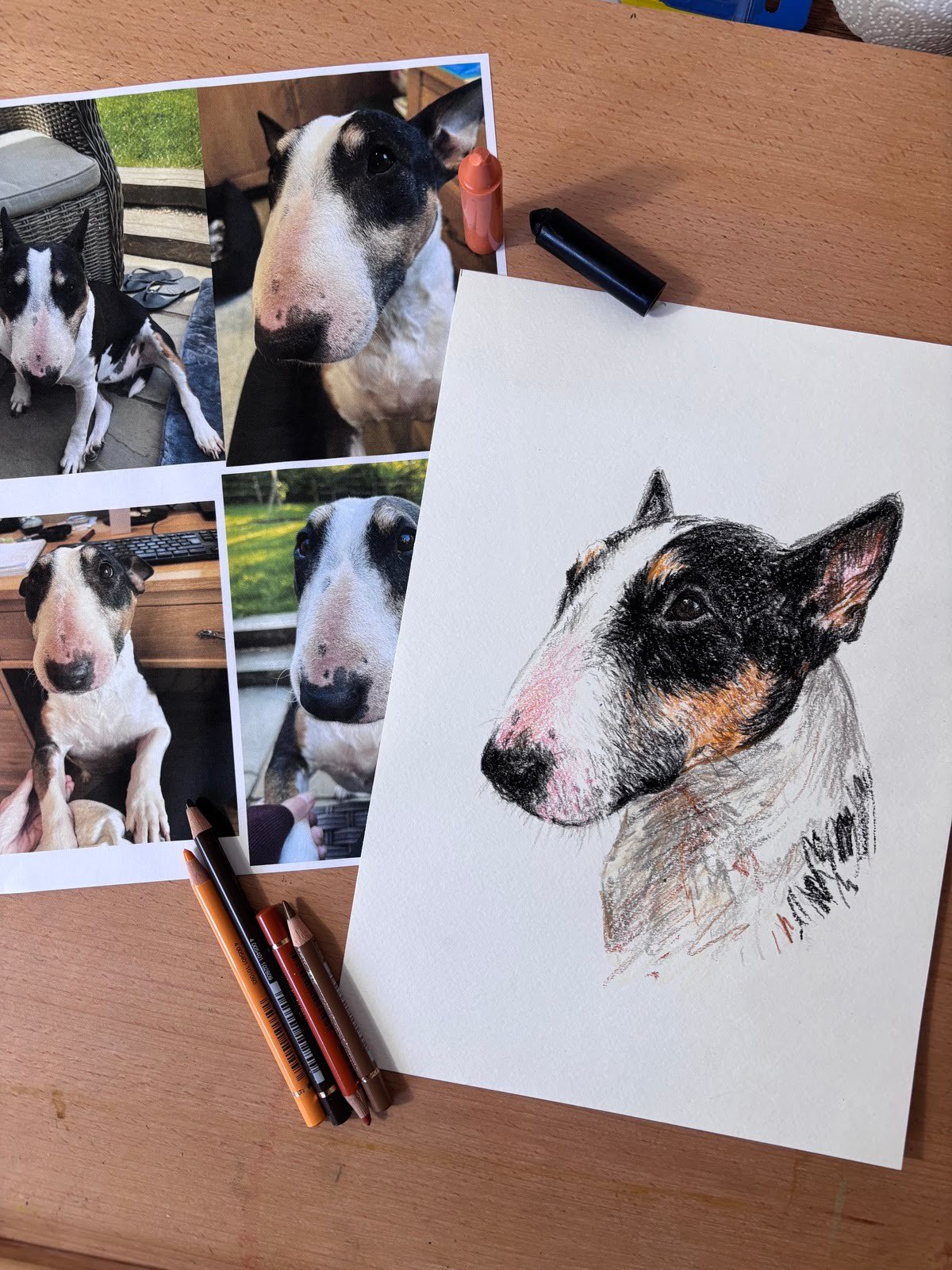
Reference photographs displayed beside the finished hand-drawn pet portrait
3. Accurate features and proportions
A convincing pet portrait needs more than well-drawn eyes or detailed fur. The underlying structure of the animal needs to feel right.
Small differences in proportion can noticeably change a pet's appearance. The muzzle may be slightly too long, the eyes too close together or the ears positioned differently, and suddenly the finished portrait can look more like the breed than the individual pet.
Important features include:
Head shape and width
Size and position of the eyes
Length and shape of the muzzle
Ear size, shape and placement
Nose shape and position
The relationship between each of these features
Getting these foundations right is particularly important before adding finer detail.
More detail doesn't automatically create a better likeness. A beautifully rendered coat can't compensate for proportions that don't convincingly represent the individual animal.
This is why I establish the main shapes, proportions and recognisable features first, before gradually developing the colour, texture and finer details of the finished portrait.
4. Colour and distinctive markings
Colour and markings can be some of the most immediately recognisable features of an individual pet.
A white patch on the chest, darker markings around one eye, differently coloured ears or even subtle variations in the coat can all contribute to whether the finished portrait feels right.
Important details can include:
Coat colour and tonal variations
Facial markings
Patches and spots
Eye colour
Nose colour
Lighter or darker areas around the muzzle
Distinctive markings on the ears, chest or paws
Photographs don't always record colour consistently. Indoor lighting, bright sunlight, shadows and phone-camera processing can all make the same coat appear different between images.
That's why I can use additional photographs to check colour and markings, even when one main photograph provides the expression and composition for the portrait.
The aim isn't simply to reproduce the colours recorded by one camera image. It's to use the available references to create artwork that convincingly represents how the pet actually looks.


5. A good reference photograph
The quality of the reference photograph has a major influence on the information available to the artist.
A strong reference doesn't need to be professionally taken. Many successful pet portraits begin with an everyday mobile phone photograph.
Ideally, the main photograph should:
Show the eyes and important facial features clearly
Be sharp enough to see useful detail
Show the pet from a natural angle
Have reasonably accurate colour
Avoid heavy filters or editing
Show an expression that feels familiar
But there's an important distinction between a technically good photograph and a good portrait reference.
A perfectly exposed, pin-sharp image isn't necessarily the best choice if it doesn't really look like your pet as you know them. A more natural photograph showing their familiar expression may provide a much stronger starting point.
Additional photographs can also be useful. I may use one image as the main reference while checking others for eye colour, coat markings or other details that aren't clear in the primary photograph.
If your favourite photograph isn't perfect, don't automatically rule it out. Send it across with any other useful images and I can advise what's possible before you order.
How to Choose the Best Photo for a Pet Portrait
6. An artistic style that feels right for you
A good pet portrait doesn't have to look like a photograph.
Pet portraits can be highly realistic, loose and expressive, colourful, minimal, traditional or contemporary. Digital illustration, coloured pencil, watercolour, acrylic and oil can all produce excellent artwork.
What matters is whether you actually like the artist's style and whether they apply it successfully while retaining a convincing likeness.
This is important when choosing an artist. Don't commission someone purely because their work is technically impressive if their finished portraits aren't something you'd personally want to display.
Look through several examples rather than one favourite piece and ask yourself:
Would I be happy if my own portrait looked like this?
For my own work, I aim for a strong, recognisable likeness combined with a contemporary hand-drawn finish. I'm not trying to reproduce a photograph exactly; the visible drawing marks, colour and texture remain part of the finished artwork.
If you're deciding between different approaches, my Hand-Drawn vs Digital Pet Portraits guide explains some of the differences.


7. Materials and craftsmanship
The materials used to create a pet portrait affect its appearance, texture and finish, but expensive materials alone don't make good artwork.
What's more important is how effectively the artist uses their chosen medium.
Different materials produce very different results. Watercolour can create soft washes and expressive marks, oils allow rich colour and depth, while pencil and coloured pencil can combine precise drawing with visible texture.
When looking at traditional artwork, consider:
Whether the materials suit the artist's style
How confidently colour and tone have been handled
Whether details remain convincing when viewed closely
Whether the surface and texture contribute to the finished piece
Whether the artist clearly explains what materials you're receiving
For my portraits, I use professional coloured pencils and wax crayons on textured watercolour paper.
Rather than hiding the drawing process, I allow some of the pencil marks, layered pigment and paper texture to remain visible. These physical details are part of the original artwork and become particularly noticeable when you look at the portrait closely.
Every commission is created directly onto paper and supplied as the original hand-drawn artwork, rather than a printed reproduction.
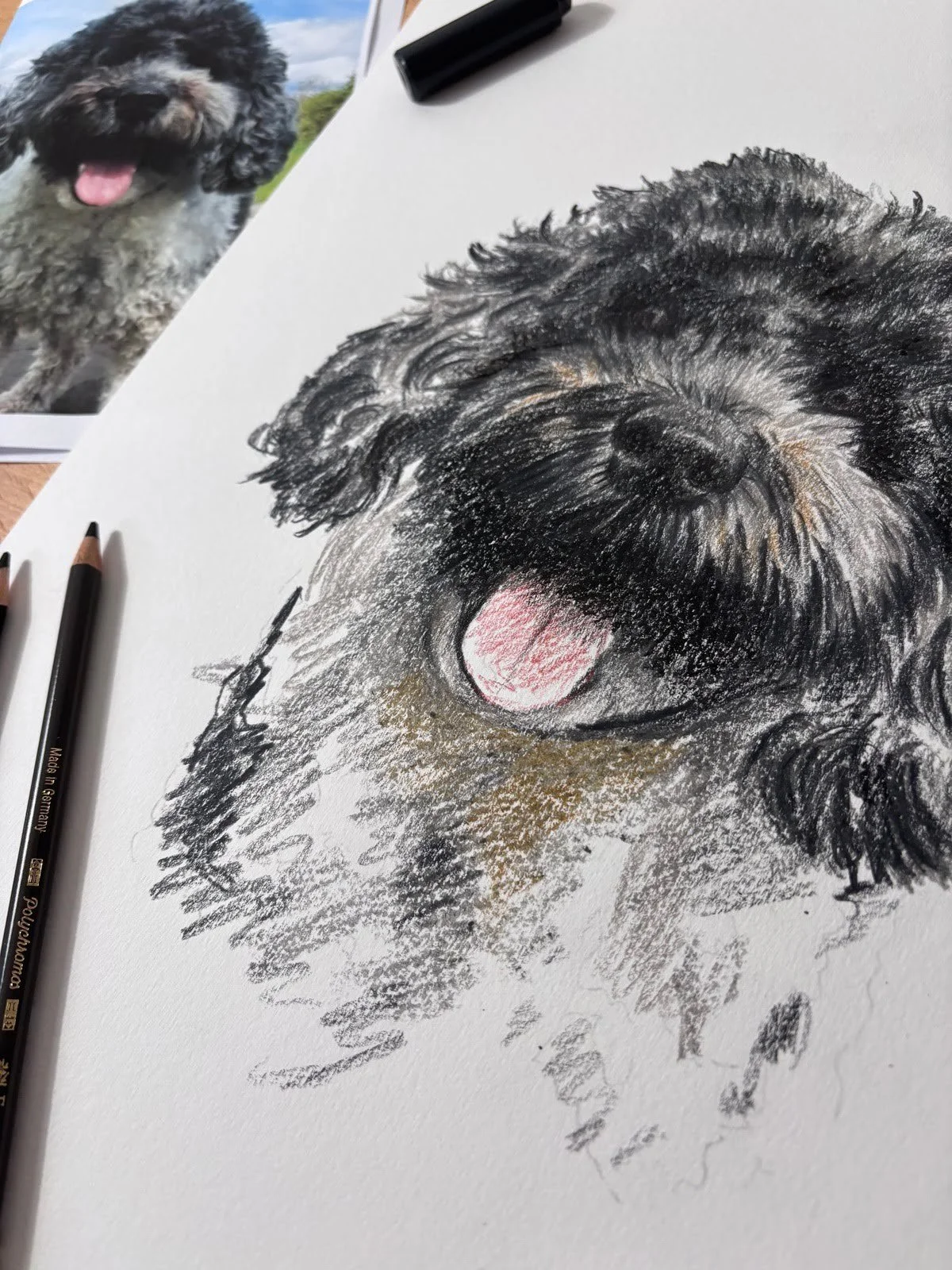
Close-up of coloured pencil and wax crayon texture on a hand-drawn pet portrait
8. Good composition
A successful pet portrait isn't only about how accurately the animal itself has been drawn. How the pet sits within the finished artwork matters too.
Composition includes decisions such as:
How closely the portrait is cropped
Where the pet is positioned on the paper
How much space surrounds the subject
The angle and direction of the pet's head
How multiple pets are positioned together
Whether a background adds to or distracts from the subject
For a single-pet portrait, a relatively simple composition can keep attention firmly on the animal. With multiple pets, more planning may be needed to make the individual subjects feel balanced as one piece of artwork.
This is particularly important when several pets are being combined from separate reference photographs. Their scale, position and relationship to one another need to work convincingly even though the original photographs were taken separately.
A good composition should ultimately feel natural rather than making you notice the decisions behind it.
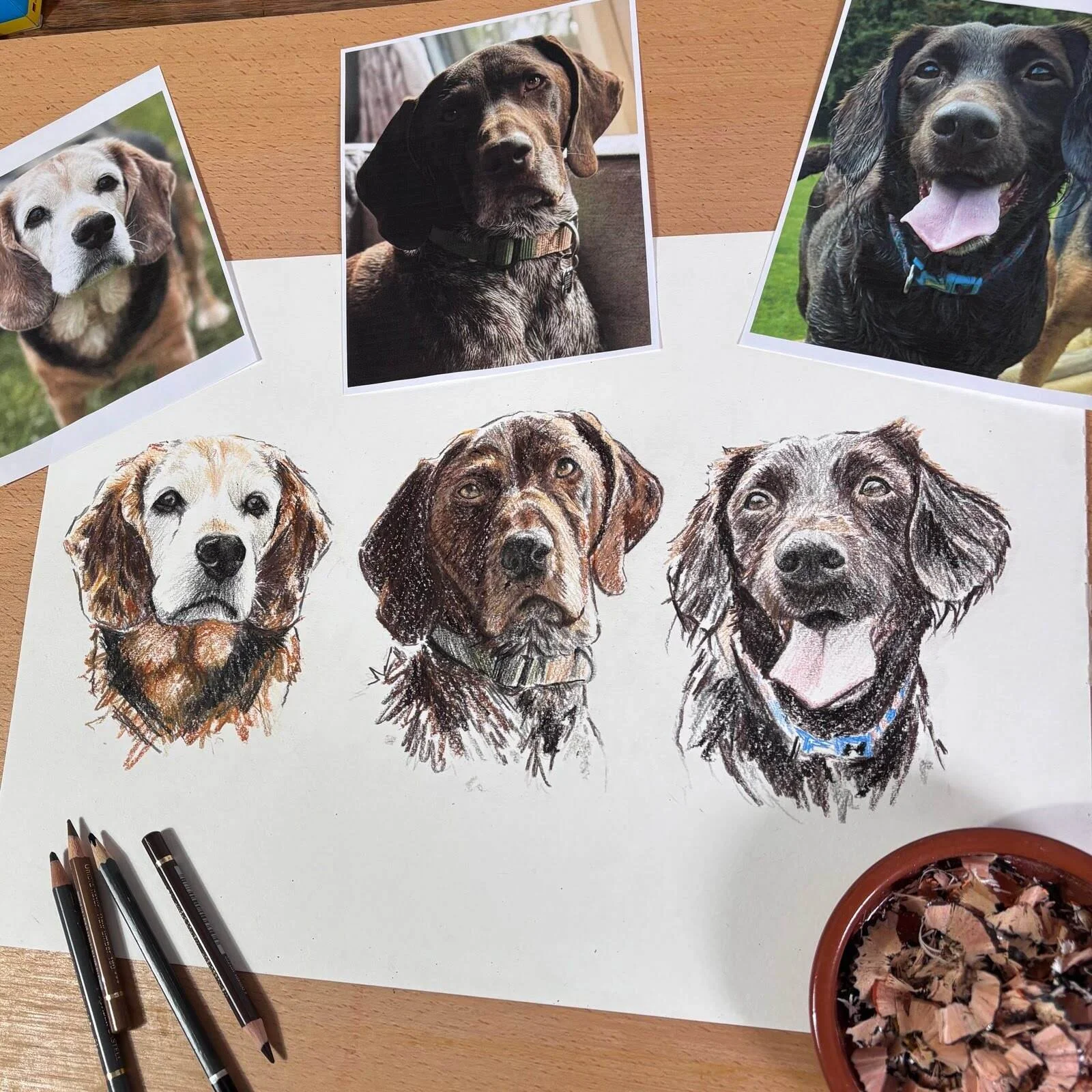
Final pet portrait alongside reference photos of three dogs
What doesn’t necessarily make a pet portrait better?
When comparing pet portraits, it's easy to assume that more detail, greater realism, a larger size or a higher price automatically means better artwork.
They don't.
Quality is better judged by whether the portrait works successfully as a whole and, most importantly, whether it convincingly represents the individual pet.
More detail
A highly detailed portrait can be technically impressive, but detail alone doesn't create likeness.
Thousands of carefully drawn hairs won't compensate for eyes that are positioned incorrectly, a muzzle that's the wrong shape or proportions that don't quite match the pet.
The underlying likeness should work before the finer detail is added.
Photographic realism
A pet portrait doesn't need to be photorealistic to be successful.
Some people prefer highly realistic artwork, while others are drawn to visible pencil marks, loose brushwork, bold colour or a more contemporary finish.
These are differences in artistic style, rather than measures of quality.
A larger portrait
Bigger isn't automatically better either.
The appropriate size depends on the number of pets, composition, level of detail and where you intend to display the finished artwork.
A well-composed smaller portrait can be every bit as successful as a much larger piece.
A higher price
Price can reflect an artist's experience, demand, materials, size and the amount of work involved, but a more expensive portrait isn't automatically the right portrait for you.
Look at the artist's actual work and what you'll receive rather than using price alone as an indication of quality.
How Much Do Pet Portraits Cost in the UK?
An elaborate background
A detailed background can work beautifully when it's part of the artist's style, but it isn't essential to a successful pet portrait.
A simpler composition can place more emphasis on the animal itself, particularly when the pet is intended to be the clear focus of the artwork.
Ultimately, the best portrait isn't necessarily the biggest, most detailed, most realistic or most expensive.
It's the one that combines a convincing likeness with an artistic style and finished result that you genuinely want to own.
How can I tell if a pet portrait artist is good?
When choosing a pet portrait artist, don't judge their work from a single impressive image. Look across their portfolio to see whether the quality and likeness remain consistent from one commission to another.
Here are some of the most useful things to look for:
Consistent quality
Look through several finished portraits rather than focusing on the artist's best piece.
Can they produce convincing results across different animals, breeds, coat types and colours? A strong portfolio should demonstrate consistent ability rather than one standout commission.
Reference photo comparisons
Where possible, look for examples showing the original reference photograph alongside the finished artwork.
This is one of the best ways to judge likeness because you can see how successfully the artist has represented the individual pet rather than simply deciding whether the artwork looks impressive.
Real customer commissions
Look for evidence of genuine commissioned work rather than only demonstration pieces.
Photographs of customers with their portraits, pets alongside finished artwork and documented commission stories can all help show how the artist works with real customer photographs.
Close-up photographs
Full portraits can look very different when viewed online at a small size.
Close-up photographs let you examine the actual drawing or painting more carefully, including the artist's mark-making, texture, detail and finish.
Customer reviews
Reviews can tell you about more than the finished artwork. They can also provide reassurance about communication, the commissioning process, delivery and the customer's overall experience.
A clear process
A professional commission should make it easy to understand what you're buying and what happens next.
Look for clear information about reference photographs, prices, sizes, turnaround times, previews, delivery and whether you're receiving an original artwork or reproduction.
How to Commission a Pet Portrait
Ultimately, choosing an artist is still subjective. You should feel confident in their ability to create a recognisable portrait, but you should also genuinely like their artistic style.
If you wouldn't want the examples in their portfolio displayed in your own home, they're probably not the right artist for you.
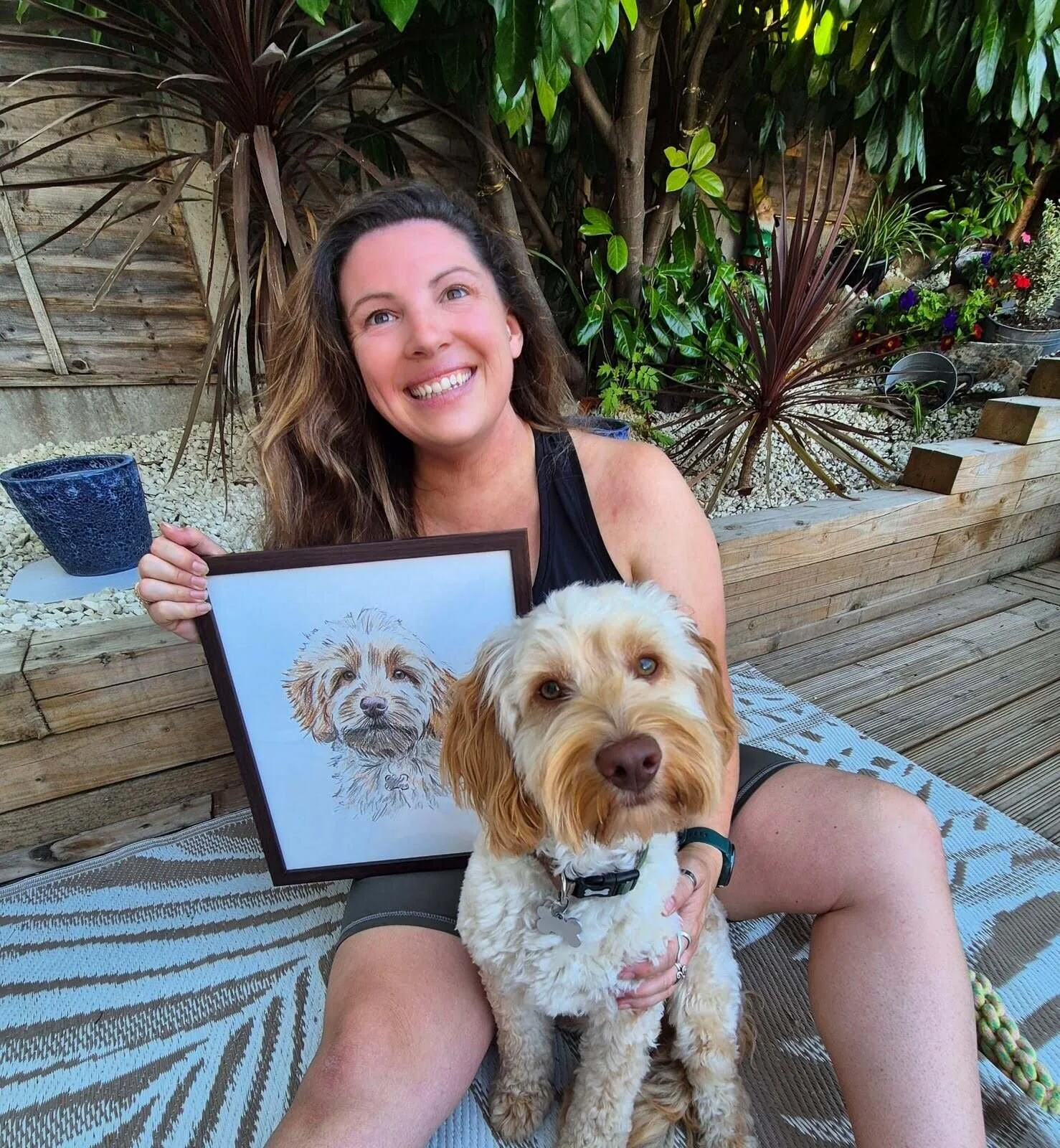
Customer and dog beside their finished hand-drawn pet portrait
What I look for in my own pet portraits
When I'm creating a pet portrait, my priorities are straightforward:
Recognisable first. Contemporary second. Hand-drawn always.
Recognisable first
The likeness has to work before anything else.
I begin by concentrating on the features and proportions that make the individual pet recognisable - the eyes, head shape, muzzle, ears, markings and familiar expression.
If those foundations don't feel right, adding more detail won't solve the problem.
Contemporary second
Once the likeness is established, I develop the portrait into a finished piece of contemporary artwork.
I'm not trying to make a photographic copy. I want the coloured pencil marks, layered colour, wax crayon and texture of the paper to remain visible as part of the finished piece.
That balance between recognisable likeness and visible drawing is central to my work.
Hand-drawn always
Every portrait is created entirely by hand using coloured pencil and wax crayon on textured watercolour paper.
There's no AI-generated artwork, digital drawing or printed image beneath the finished piece. The portrait you receive is the original artwork created in my studio.
The aim is ultimately simple: when you see the finished portrait, I want you to recognise your pet immediately while still being able to see and enjoy the fact that you're looking at an original drawing.
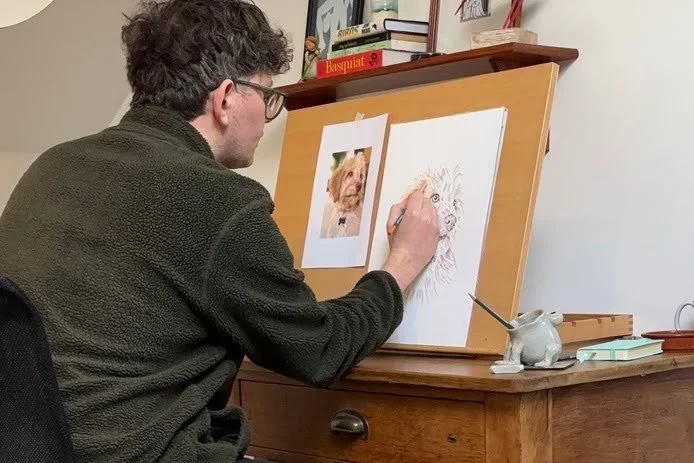
UK pet portrait artist Jonny Atkinson creating an original hand-drawn pet portrait
Frequently asked questions
-
For me, it's recognisable likeness. The proportions, features, markings and expression should convincingly represent the individual pet before finer details or artistic style are considered.
-
No. Photorealism is one artistic style rather than a measure of quality. A portrait can use visible pencil marks, expressive brushwork or a more contemporary style while still creating a strong, recognisable likeness.
-
Where possible, look for reference photographs alongside finished portraits. Compare the head shape, eyes, muzzle, ears, markings and expression rather than judging the amount of detail alone.
-
Yes. Many successful portraits are created from everyday phone photographs. The most important things are that useful features are visible and the photograph shows an expression that feels familiar.
-
Don't automatically rule it out. Additional photographs can sometimes provide information that's missing from your favourite image, such as eye colour, coat markings or finer details. I can review your photographs before you order.
-
Not necessarily. Fine detail can add to a portrait, but it can't compensate for incorrect proportions or a weak likeness. The underlying structure and recognisable features need to work first.
-
No. Backgrounds are an artistic and compositional choice. A simple or blank background can keep the focus entirely on the pet, while other artists may use detailed surroundings as part of their style.
-
Look for consistent quality across several commissions, reference-to-finished comparisons, real customer work, close-up photographs, reviews and a clearly explained commissioning process. Most importantly, choose an artist whose finished style you genuinely like.
-
Neither is inherently better. They're different ways of creating artwork. The right choice depends on the style you prefer and whether you want an original physical artwork, a digital piece or a printed reproduction.
-
You can explore my Portrait Stories to see real commissions, including reference photographs, finished artwork and the story behind individual portraits.
Continue reading
If you're comparing pet portrait artists or thinking about commissioning your own artwork, these guides will help with some of the most important decisions.
How to choose the best photo
Learn what makes a strong reference photograph, which details matter most and what to do if your favourite image isn't perfect.
Choose the Best Reference Photo
Hand-drawn vs digital pet portraits
Compare traditional and digital pet portraits, including how they're created, what the finished artwork is like and what you ultimately receive.
Compare Hand-Drawn & Digital Portraits
Portrait stories
See real commissions from reference photograph to finished artwork, including the decisions and drawing process behind individual portraits.
Ready to commission your pet portrait?
If you're looking for a pet portrait that puts recognisable likeness first, I'd love to create an original hand-drawn portrait of your pet.
Every commission begins with your photographs. I focus first on the features, proportions, markings and familiar expression that make your pet immediately recognisable, before developing the portrait into a finished piece of contemporary artwork.
Each portrait is created entirely by hand using coloured pencil and wax crayon on textured watercolour paper, and the artwork you receive is the original drawing created in my studio.
If you're unsure whether your photographs are suitable or have any questions before ordering, you're always welcome to get in touch.
Finished hand-drawn pet portrait displayed beside the original reference photograph